# How natural strategists think (print this)
Canonical: https://social-archive.org/fuchikoma/nkgAvn2paH
Original URL: https://alexmhsmith.substack.com/p/print-this-the-4-most-basic-things
Author: Alex M H Smith
Platform: substack
## Content
• • Before we get into it, remember in one month’s time on May 7th, I’ll be holding a live discussion for paid subscribers on the end of competence, and the rise of the charismatic business. To register and join, follow the link here. ___ If you could really understand the 4 points in this essay? You’d never need to read any of my stuff ever again. You’d also never need to get an MBA. Hire a big consultancy firm. Watch instructional YouTube videos. Or do any serious business education other than just getting out there, and playing the game. We know this is true, because people have done it. There are totally “uneducated” founders out there who are far more successful than you, or me. Founders who’ve barely read a book, but who defeated corporations with armies of MBAs and oceans of data at their disposal. These people know a tiny fraction of what their rivals do. They’d probably be humiliated by them in a seminar, or around a boardroom table. But they do know these 4 things in this essay. The 4 things that make someone a natural strategist. I say natural because these are not techniques and frameworks that require “learning”. Instead they are fundamental assumptions about business that some people just have as their default - colouring every decision they make, and which over time add up to massive competitive advantage. Sadly, these assumptions are not natural for most of us. That’s why I know that even after reading this piece, you’re not going to magically become a business savant. Even as we nod along to this kinda stuff, it hasn’t really seeped into our bones in a way that lets us act on it instinctively. We “get it”, but then go do something else. But, with enough reps, little by little, we can reprogram ourselves to act this way. So let that reprogramming start now, with these most basic, simple, foundational ideas about strategy, that should be running in the background of our thoughts 24/7. At the end I’ve given you a little poster to print out and stuck to your desk so you can keep these top of mind. I. To get different results, you must do different thingsYes, I told you these were basic. But that doesn’t mean you’re doing them. This first one is a variation on the supposed Einstein quote about how the definition of insanity is doing the same thing over and over again and expecting different results. Well that might be true, but my version of it is a little different: The definition of insanity is doing the same thing as other people and expecting different results. It should be possible to ask every CEO on the planet what one big “different thing” they are doing that their competitors aren’t, and get a compelling answer. Only you won’t, because on the whole everybody is doing the same things, just to varying degrees of quality. This is the problem of “best practice”, and obviously leads to commodification and a competitive dogfight that serves nobody (other than the guy who’s the most famous / has the most money). In the past this wasn’t that big an issue because: • Execution was more difficult • Competitors would often fail to deliver on best practice • And lack of expertise would result in lots of “accidental” differentiation But now, especially post-AI, people’s ability to successfully execute best practice is becoming greatly enhanced, leading to even more competition and commodification than we had before. You know that feeling of franticness you feel out there right now? The feeling of everyone racing just to keep up with average? This is why. Unfortunately because human beings are naturally mimetic - that is, we like to copy each other - most of us will unwittingly accelerate this problem with every decision we make. Vanishingly few of us are attracted to doing something different from our peers. But, surprise surprise, those weirdos are the natural strategists, and the people who win. II. Businesses exist to create value, not solve problemsThe internet has this extreme homogenising effect, whereby certain ideas “win the algorithmic battle”, and so become accepted truth, even though there are other equally legitimate but less viral alternatives. One example of this is the idea that businesses exist to “solve customer problems”. This has become almost universal dogma now, and it’s something I find myself often raging against because it’s just… not… true. Yes, some businesses do indeed become successful because they solve customer problems. This is totally legitimate, and there’s nothing wrong with it. But this isn’t the universal pattern behind all successful businesses; it’s merely a subset. The universal pattern isn’t to solve problems, but to create value. Most people don’t understand the difference, so let me explain. Solving problems requires customers to have some kind of conscious issue, to which you provide a remedy. Creating value is broader, in that it means generating something people want, that wasn’t there before. So to pick an extreme example, Disney World created colossal amounts of value, but it didn’t really “solve any customer problems”. Of course if we put our “jobs to be done” hat on, we could post-rationalise certain problems that it does solve (“a place to go on vacation” or whatever), but it’s ludicrous to suggest that this is how the idea was generated in the first place. (This is why I don’t really like JTBD as a technique because it often has this reductive effect, though presumably only when people use it wrong) Natural strategic thinkers don’t “obsess over customer problems” like the manager of some 5 star hotel. They obsess over creating value, which is a far more expansive and creative way of operating, with so many more avenues to explore. Subscribe now III. Only is better than bestAh, a faithful friend to my long-time readers. “Only is better than best” is really just an elegant way of saying: Supply and demand matters. Again, another simplistic statement everyone will nod along to - but do you truly embrace what this means? Supply and demand are the fundamental forces that govern all businesses, everywhere, and at all times. And therefore, behind all the hot air, they are the only two levers we need to pull in order to make a business grow: • We need to increase demand • We need to decrease supply That is it. That is the entire game. The problem is that most people pay far more attention to increasing demand than they do to lowering supply. Most people believe that if you create something people want / need, then that’s it, you’ve done enough. But you haven’t, because if that thing is in high supply (as it normally is) then you still can’t make money from it. This is why you need to simultaneously think about lowering supply - which simply means making sure you are the only game in town for that thing. That is the meaning of “only is better than best”, and why that little ditty is so valuable, because it shortcuts you past one of the most common strategic mistakes. IV. Innovation comes from sacrificeIt should be clear that in order to adhere to the first three points, a business needs to innovate. Innovation is the core purpose of every business on the planet. After all, if you aren’t putting something new into the world, then really what is the point of you? But this is where most people hit a brick wall because, well, it’s very hard to come up with new ideas! Again this is quite a modern disease. Forty years ago the market wasn’t so crowded as it is now, and there was plenty of low-hanging fruit to be picked. But today there simply isn’t. It’s like all the good ideas have been taken. So where do we find some more? The answer is that we find them on the other side of sacrifice. In other words, they reveal themselves when we give up on something that most people in our category consider to be extremely important and valuable. When we do this, new ideas that were impossible to execute simultaneously with the sacrificed thing come into play. These ideas are not only new - they are invisible to our competitors, because they had never considered a world without that thing we’re cutting. Sacrifice is essentially the same thing as “the appetite to take risks”, but I think it’s more practical to speak in terms of sacrifice as it helps us understand more clearly how it leads to creating new value. Turning these concepts into habitsOK now you understand the ideas intellectually. But, let’s be real, you’re probably going to carry on just the same. Heck, many of you probably already understood these concepts, but still didn’t really act on them. So to fix this, let’s turn the concepts into questions we can ask ourselves, every day, to move us into the right zone of thinking. Below there are four I’ve created, with the goal of being as uncompromising, and difficult to bullshit with as possible. • What is one big thing we are doing that nobody else is? • What would the world miss if we disappeared tomorrow? • Would our competitors say they do what we do? • What am I willing to let my competitors have for themselves? Here’s a version you can print out and stick somewhere, if you wish. Or to drill it deeper, maybe even write them by hand to make your own. • • That’s already a great place to start. And if you stick with me here at The Rare Mind, over time, my goal is to help you build these muscles further and further with every passing week. The Rare Mind is a reader-supported publication. To receive the latest posts and support my work, consider becoming a free or paid subscriber. --- Before we get into it, remember in one month’s time on May 7th, I’ll be holding a live discussion for paid subscribers on the end of competence, and the rise of the charismatic business.
To register and join, follow the link here.
___
If you could really understand the 4 points in this essay?
You’d never need to read any of my stuff ever again.
You’d also never need to get an MBA. Hire a big consultancy firm. Watch instructional YouTube videos. Or do any serious business education other than just getting out there, and playing the game.
We know this is true, because people have done it.
There are totally “uneducated” founders out there who are far more successful than you, or me.
Founders who’ve barely read a book, but who defeated corporations with armies of MBAs and oceans of data at their disposal. These people know a tiny fraction of what their rivals do. They’d probably be humiliated by them in a seminar, or around a boardroom table.
But they do know these 4 things in this essay.
The 4 things that make someone a natural strategist.
I say natural because these are not techniques and frameworks that require “learning”. Instead they are fundamental assumptions about business that some people just have as their default - colouring every decision they make, and which over time add up to massive competitive advantage.
Sadly, these assumptions are not natural for most of us.
That’s why I know that even after reading this piece, you’re not going to magically become a business savant. Even as we nod along to this kinda stuff, it hasn’t really seeped into our bones in a way that lets us act on it instinctively. We “get it”, but then go do something else.
But, with enough reps, little by little, we can reprogram ourselves to act this way.
So let that reprogramming start now, with these most basic, simple, foundational ideas about strategy, that should be running in the background of our thoughts 24/7.
At the end I’ve given you a little poster to print out and stuck to your desk so you can keep these top of mind.
I. To get different results, you must do different things
Yes, I told you these were basic. But that doesn’t mean you’re doing them.
This first one is a variation on the supposed Einstein quote about how the definition of insanity is doing the same thing over and over again and expecting different results. Well that might be true, but my version of it is a little different:
The definition of insanity is doing the same thing as other people and expecting different results.
It should be possible to ask every CEO on the planet what one big “different thing” they are doing that their competitors aren’t, and get a compelling answer. Only you won’t, because on the whole everybody is doing the same things, just to varying degrees of quality.
This is the problem of “best practice”, and obviously leads to commodification and a competitive dogfight that serves nobody (other than the guy who’s the most famous / has the most money).
In the past this wasn’t that big an issue because:
Execution was more difficult
Competitors would often fail to deliver on best practice
And lack of expertise would result in lots of “accidental” differentiation
But now, especially post-AI, people’s ability to successfully execute best practice is becoming greatly enhanced, leading to even more competition and commodification than we had before.
You know that feeling of franticness you feel out there right now? The feeling of everyone racing just to keep up with average? This is why.
Unfortunately because human beings are naturally mimetic - that is, we like to copy each other - most of us will unwittingly accelerate this problem with every decision we make. Vanishingly few of us are attracted to doing something different from our peers.
But, surprise surprise, those weirdos are the natural strategists, and the people who win.
II. Businesses exist to create value, not solve problems
The internet has this extreme homogenising effect, whereby certain ideas “win the algorithmic battle”, and so become accepted truth, even though there are other equally legitimate but less viral alternatives.
One example of this is the idea that businesses exist to “solve customer problems”.
This has become almost universal dogma now, and it’s something I find myself often raging against because it’s just… not… true.
Yes, some businesses do indeed become successful because they solve customer problems. This is totally legitimate, and there’s nothing wrong with it. But this isn’t the universal pattern behind all successful businesses; it’s merely a subset.
The universal pattern isn’t to solve problems, but to create value.
Most people don’t understand the difference, so let me explain.
Solving problems requires customers to have some kind of conscious issue, to which you provide a remedy. Creating value is broader, in that it means generating something people want, that wasn’t there before.
So to pick an extreme example, Disney World created colossal amounts of value, but it didn’t really “solve any customer problems”.
Of course if we put our “jobs to be done” hat on, we could post-rationalise certain problems that it does solve (“a place to go on vacation” or whatever), but it’s ludicrous to suggest that this is how the idea was generated in the first place.
(This is why I don’t really like JTBD as a technique because it often has this reductive effect, though presumably only when people use it wrong)
Natural strategic thinkers don’t “obsess over customer problems” like the manager of some 5 star hotel. They obsess over creating value, which is a far more expansive and creative way of operating, with so many more avenues to explore.
Subscribe now
III. Only is better than best
Ah, a faithful friend to my long-time readers.
“Only is better than best” is really just an elegant way of saying:
Supply and demand matters.
Again, another simplistic statement everyone will nod along to - but do you truly embrace what this means?
Supply and demand are the fundamental forces that govern all businesses, everywhere, and at all times. And therefore, behind all the hot air, they are the only two levers we need to pull in order to make a business grow:
That is it.
That is the entire game.
The problem is that most people pay far more attention to increasing demand than they do to lowering supply. Most people believe that if you create something people want / need, then that’s it, you’ve done enough.
But you haven’t, because if that thing is in high supply (as it normally is) then you still can’t make money from it. This is why you need to simultaneously think about lowering supply - which simply means making sure you are the only game in town for that thing.
That is the meaning of “only is better than best”, and why that little ditty is so valuable, because it shortcuts you past one of the most common strategic mistakes.
IV. Innovation comes from sacrifice
It should be clear that in order to adhere to the first three points, a business needs to innovate.
Innovation is the core purpose of every business on the planet. After all, if you aren’t putting something new into the world, then really what is the point of you?
But this is where most people hit a brick wall because, well, it’s very hard to come up with new ideas!
Again this is quite a modern disease. Forty years ago the market wasn’t so crowded as it is now, and there was plenty of low-hanging fruit to be picked. But today there simply isn’t.
It’s like all the good ideas have been taken.
So where do we find some more?
The answer is that we find them on the other side of sacrifice.
In other words, they reveal themselves when we give up on something that most people in our category consider to be extremely important and valuable. When we do this, new ideas that were impossible to execute simultaneously with the sacrificed thing come into play.
These ideas are not only new - they are invisible to our competitors, because they had never considered a world without that thing we’re cutting.
Sacrifice is essentially the same thing as “the appetite to take risks”, but I think it’s more practical to speak in terms of sacrifice as it helps us understand more clearly how it leads to creating new value.
Turning these concepts into habits
OK now you understand the ideas intellectually.
But, let’s be real, you’re probably going to carry on just the same. Heck, many of you probably already understood these concepts, but still didn’t really act on them.
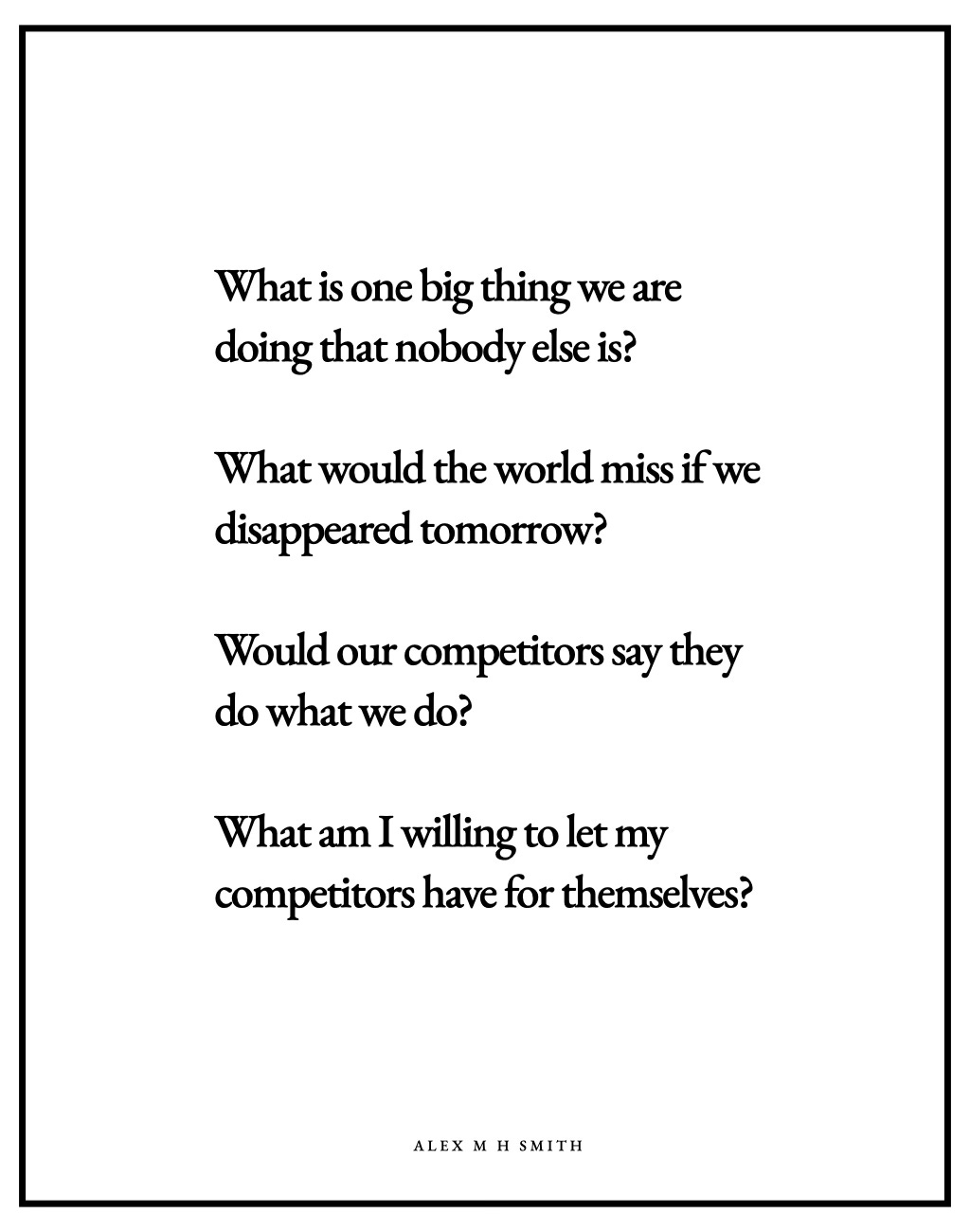
So to fix this, let’s turn the concepts into questions we can ask ourselves, every day, to move us into the right zone of thinking. Below there are four I’ve created, with the goal of being as uncompromising, and difficult to bullshit with as possible.
What is one big thing we are doing that nobody else is?
What would the world miss if we disappeared tomorrow?
Would our competitors say they do what we do?
What am I willing to let my competitors have for themselves?
Here’s a version you can print out and stick somewhere, if you wish. Or to drill it deeper, maybe even write them by hand to make your own.
That’s already a great place to start.
And if you stick with me here at The Rare Mind, over time, my goal is to help you build these muscles further and further with every passing week.